

 Русский
 Italiano
 Français
 Español
 Deutsch
 العربية

Storage and Handling Advice’s For Customers
UNICOIL products are manufactured according to the highest national and international Quality Standards practiced in Metal and Organic Coating Industry followed by Best Practices in Packaging and shipping. While Unicoil’s responsibility ends by delivering the products in good condition, it realizes that damages can take place if proper care is not taken during handling and storage, after receipt by its customers. To derive the maximum benefit by its customers, UNICOIL formulated the guidelines/best practices for Handling and storage of Galvanized Steel Coils and sheets. The goal is to eliminate avoidable problems and reduce the need for additional work and material loss.
Two important elements to be avoided during Handling and Storage of Galvanized Steel sheets and Coils:
Physical Damage
- Coil Collapse
- Dents
- Warpage of Sheets
- Surface Scratches
- Degradation of Coating
- Storage Stain/White Rust
- Fretting Corrosion Marks
Guidelines for preventing Physical Damage for Coils:
- Galvanized Steel Coils of width >600mm are supplied in Bore Horizontal Condition.
- Single row Coil stacking is the most preferred method to avoid Coil Collapse and possibilities of Dents.
- However, two-hi coil stacking is acceptable subject to following.
Coils on the bottom row are to be chocked as shown in Fig 1.a,b,c. Each coil to be choked on both sides and adjacent coils touching each other without gap.
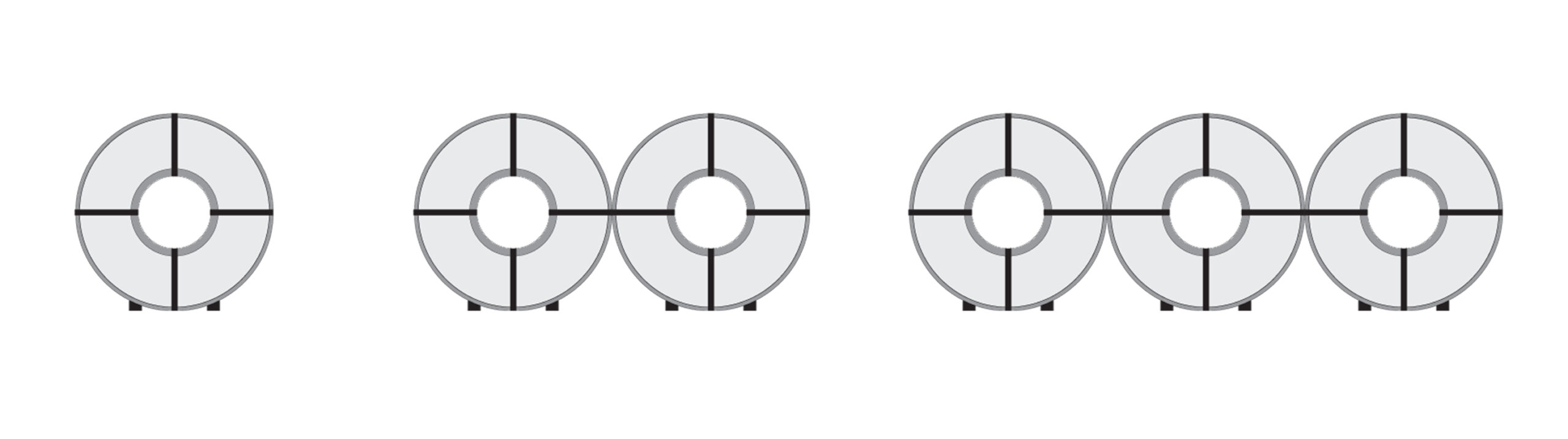

- For Two – High stacking, smaller weight coils to be placed on top of Bigger weight coils as shown in Fig 3 to avoid collapse of coils. Also the width of the top row coil should be less than or equal to the width of the bottom row coils.

- For Two-High Stacking, the adjacent coils on the bottom row should be touching to each other, shown in Fig4 to avoid collapse of coils.

For a Two-high stacking, the top coil should be placed centrally and aligned as shown,

- To prevent dents, Galvanized Steel Coils should always be stored on a stable, clean, dry, flat and level surface. Care should be taken to avoid strapping joints creating dents on the galvanized steel surface.
- The ideal position of the strapping joint in a circumferential band, is at either 10 o’clock, 12 o’clock or 2 o’clock to avoid contact with the ground, chocks / cradles and adjacent coils as shown in fig 6a,b
- The distance between two rows of coils should be adequate to avoid unintentional damage by lifting tackles to Galvanized steel coils.

Guidelines for preventing Physical Damage for Sheets:
- Securely Packed Galvanized Steel Sheets/bundles are always supplied on wooden Pallets made with transverse wooden members of minimum 60mmx60mm cross section to allow safe lifting and handling gear.
- Use certified web slings for handling the bundles by crane. Do not use steel wire ropes.

- Use Steel Beams to lift bundles of more than 4mtr length, by crane as shown in fig 8 to avoid warpage of sheets. Do not use belts in an obtuse angle and do not choke the material to avoid damage.

- Use Fork lift to lift bundles of less than 4 mtrs length as shown in Fig 9 to avoid warpage of sheets.

- Galvanized steel sheet bundles should be stored flat on level ground and in a covered Shed.

- While multi stacking of Galvanized sheets/bundles is a common practice, following precautions are to be taken to avoid warpage/damage to the galvanized sheets.
- To ensure the stack stability, the stack height should be limited. For sheets of >600mm width and length of >1000mm, the max stack height should be limited to 1500mm.
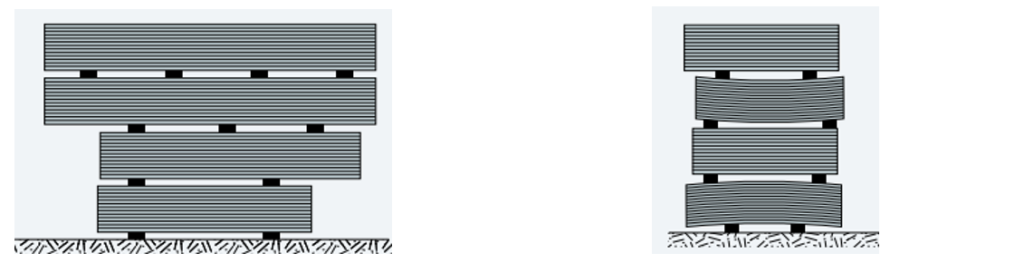
As far as possible, stack bundles of same dimensions. The bundles should be aligned properly as shown.

Do not stack longer bundles on shorter bundles to avoid warpage of sheets as shown,
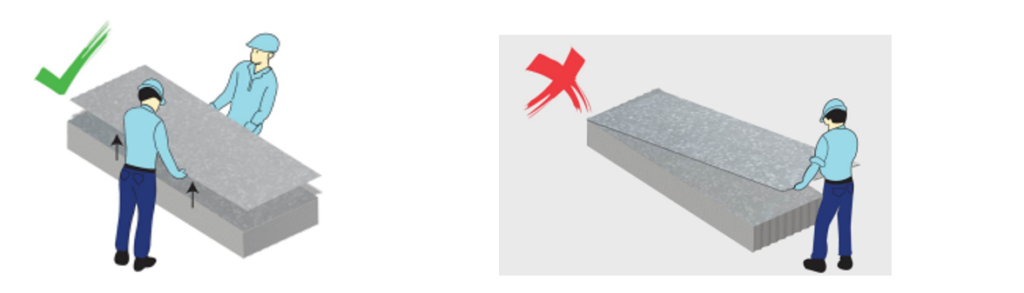
To avoid surface scratches while lifting sheets from the bundle, lift the sheet from both sides and not from one side as shown below.,
- Reasons for Degradation of Coating:
- Storage stain/White Rust on Galvanized Steels is a corrosion product.
- It can occur when sheets of Galvanized products that are in close contact (in a coil or stacked bundles) get wet either by Direct Water intrusion or condensation between the surfaces.
- Rapid temperature changes may induce condensation between coil wraps/sheets or panels.
- The reaction of zinc with moisture in the absence of free air circulation leads to corrosion products leading to discoloration and termed as storage stain/white rust.
- Typical Storage stain/White Rust is shown
- If Galvanized Steel is kept dry, Storage stain/White Rust will never be an issue.

- Fretting Corrosion Marks are a surface imperfection that appear as permanent black spots, marks, lines/patches.
- Fretting corrosion Marks are generated, between interface of two adjacent surfaces, under load subjected to vibration/repeated relative motion – that usually occurs during transportation of Galvanized steel coils or sheets.
- Fretting marks on Galvanized Steel are a surface oxide phenomenon and is an aesthetic issue and does not have a negative effect on corrosion resistance.
Typical images of fretting corrosion are shown

- Guidelines for preventing Coating Degradation:
- Main Recommendations are
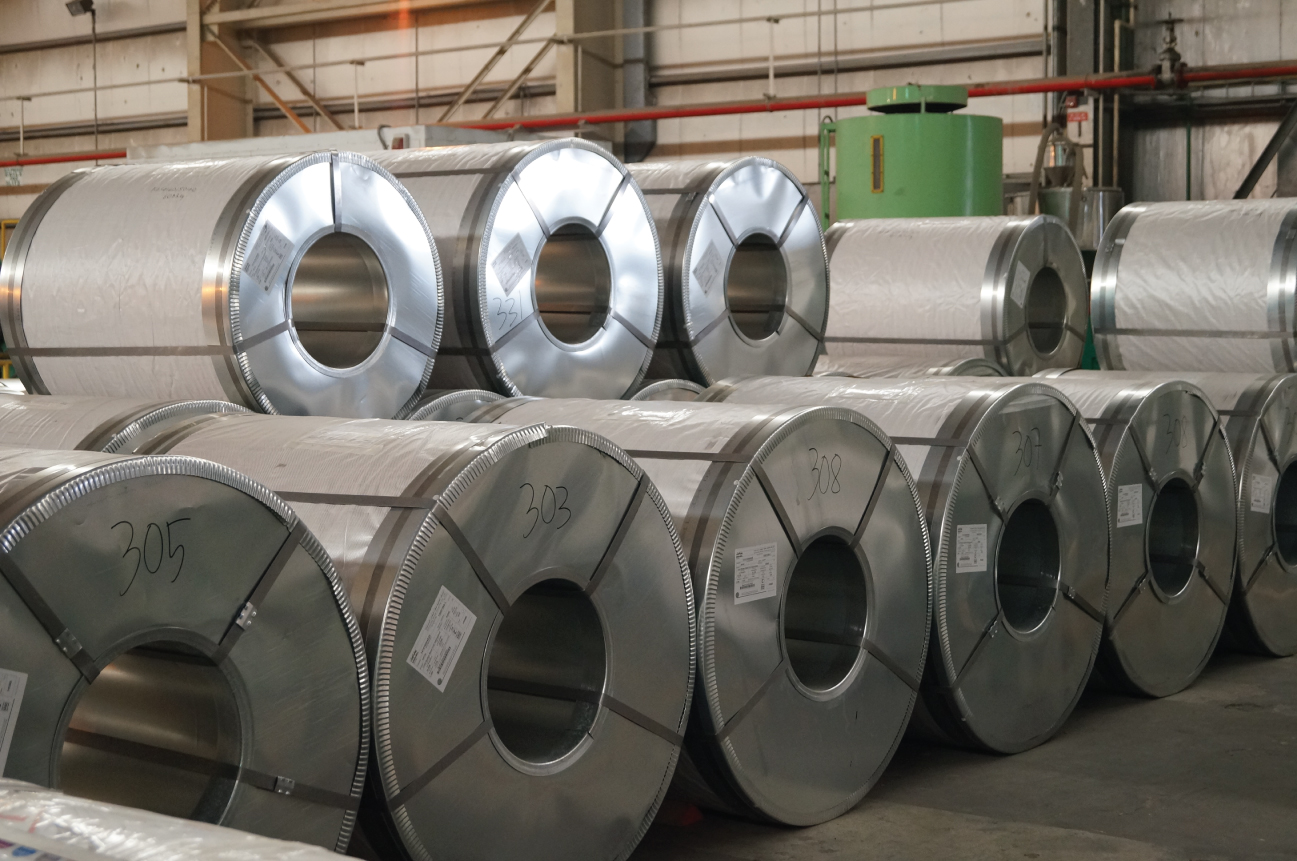
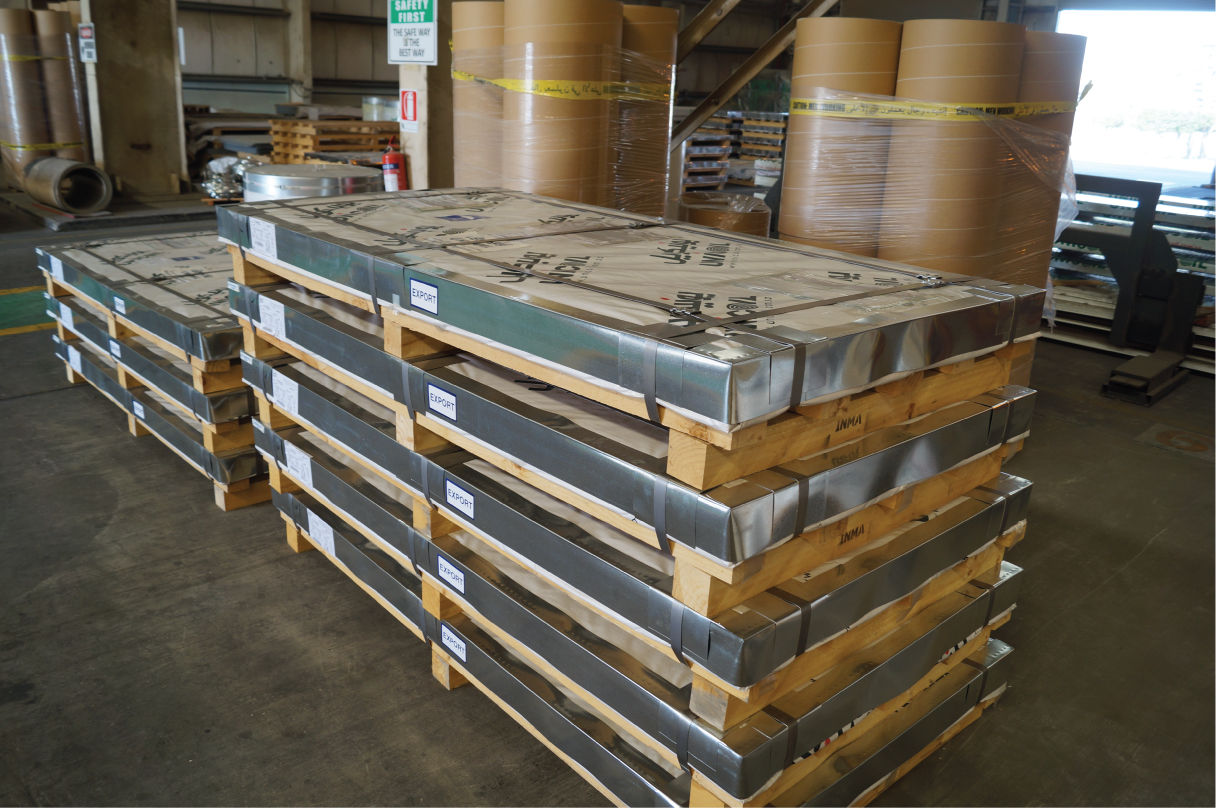
- Store inside/under covered shed
The best way to ensure coils/sheets keep their initial aspect and properties is to store them inside, under a covered shed as shown in
Keep Dry :
- If the coils/sheets cannot be stored inside, specific care should be taken to ensure they remain dry.
- Cover with polyethylene/plastic/tarpaulin sheet to protect from rain.
- In case of sheets Store on levelled ground at a slope of 3 to 5° for easy draining of water in case of rain water ingression.
- If rain water ingress is suspected, separate the sheets as quickly as possible and wipe & dry and use as quickly as possible.
- In case of coils to be stored in open area, store the coils on pallets to avoid water ingress into the bottom portion of the coil and cover with polyethylene/plastic/tarpaulin sheet to protect from rain.
- Provide good ventilation to avoid build-up of moisture between coil wraps

- Avoid Condensation
- Best practice is to store coils in a room kept at a constant temperature with good ventilation.
- If the above cannot be followed, avoid sudden temperature changes, especially in humid conditions, while moving coils from unheated warehouse at a temperature of Zero Deg.C to a heated area, around 20 Deg.c temperature areas.
Inspect the storage site:
- Inspect the storage site, especially when stored outside in open area, for any damages to packing to ensure water/moisture has not penetrated the bundles/coils.
Use Promptly:
- As the mechanical properties of the base material such as Tensile strength, Yield Strength, Elongation change over time and the sheen and aspect of the coating deteriorate overtime, it is recommended that the coils/sheets are used quickly, following FIFO (First in First out).
- UNICOIL recommends maximum storage time of three months from the date of delivery.